
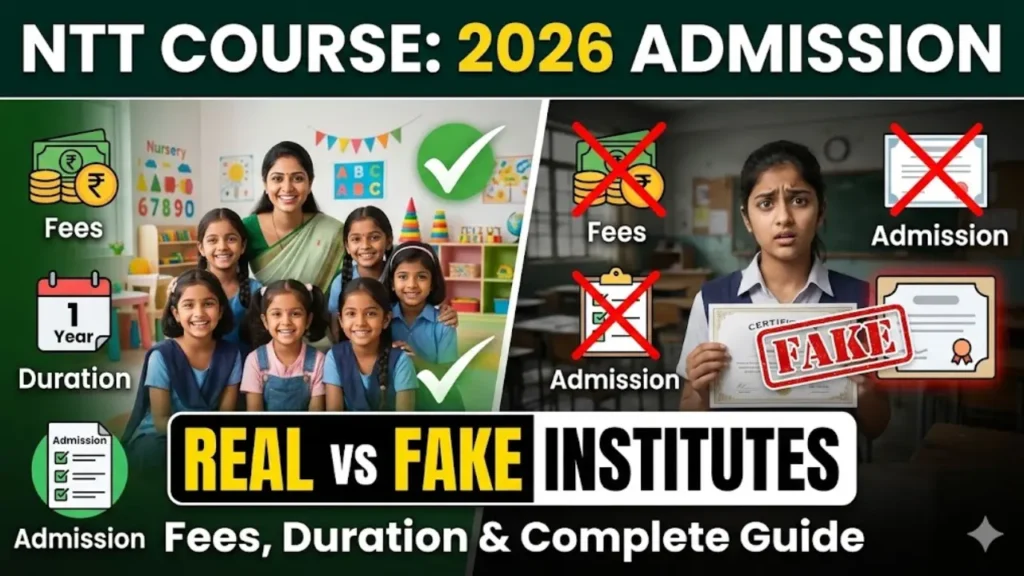
Are you dreaming of becoming a pre-primary teacher but feeling completely confused about the NTT course fees and admission process? You are not alone. In our experience guiding hundreds of aspiring teachers, the biggest fear is paying high fees to a fake or unrecognized institute.
With the implementation of the new education policies in 2026, getting a valid teaching certification is more crucial than ever. Whether you want to teach in a private play school or apply for government Anganwadi jobs, a recognized diploma is your first step.
In this comprehensive guide, we will break down the exact Nursery Teacher Training course duration, hidden costs, eligibility criteria, and how to verify if your institute is genuine.
| Course Full Form | Nursery Teacher Training (NTT) |
| Average NTT Course Fees | ₹10,000 to ₹45,000 (Depends on Institute) |
| Course Duration | 1 Year (Diploma) / 2 Years (Advanced Diploma) |
| Minimum Eligibility | 12th Pass (Any Stream with 50% marks) |
| Approving Body | NCTE (National Council for Teacher Education) |
1. What is NTT (Nursery Teacher Training) in 2026?
NTT is an undergraduate diploma program designed specifically to train teachers for pre-primary levels (Nursery, LKG, UKG). The goal is not just to teach academics, but to understand child psychology and cognitive development.
We highly recommend this course for women looking to restart their careers or students who want a respectable, stress-free job with good working hours.
Under the latest NEP 2020 Guidelines, the traditional “NTT” is gradually being updated and rebranded as ECCE (Early Childhood Care and Education). If an institute offers an ECCE diploma instead of NTT, do not worry—they hold the same value for pre-primary teaching jobs.
2. Eligibility Criteria: Who Can Apply?
The best part about the Nursery Teacher Training course is its accessibility. You do not need a complex educational background to start this journey.
- Education: You must have completed your 10+2 (12th standard) from a recognized board (CBSE, ICSE, or State Board).
- Marks Required: A minimum aggregate of 50% marks in 12th grade. (Reserved categories often get a 5% relaxation).
- Age Limit: The minimum age is 18 years. The great news is that there is generally no upper age limit for this course!
- Stream: Students from Any stream (Arts, Commerce, or Science) are eligible to apply.
Now that you know you are eligible, the next big question is the cost. In the next section, we will do a deep dive into the NTT course fees structure across Government, Private, and Distance learning modes.
3. NTT Course Fees Structure 2026: A Deep Dive
In our experience consulting with educational institutes across India, we have seen that the Nursery Teacher Training course fees vary wildly. It entirely depends on the reputation of the institute, the location (Tier 1 city vs. Tier 3 city), and the mode of education.
To make it simple for you to decide, we have categorized the fees into three distinct modes: Government, Private, and Distance Learning.
| Mode of Study | Estimated Fees (1 Year) | Best Suited For |
|---|---|---|
| 1. Government Institutes (DIET/State) | ₹8,000 – ₹15,000 | Students looking for the highest authenticity at the lowest cost. Admission is mostly merit-based. |
| 2. Private Colleges (Regular Mode) | ₹20,000 – ₹45,000 | Those who want better infrastructure, practical exposure, campus placements, and direct admission. |
| 3. Distance / Online Mode (IGNOU etc.) | ₹12,000 – ₹25,000 | Working women or mothers who cannot attend regular daily classes but want a valid certification. |
A. Hidden Costs to Watch Out For
When an institute quotes you the NTT course fees, it usually only covers the tuition. Always ask about the “hidden costs” before taking admission.
- Examination Fees: Usually charged separately every semester (around ₹1000 – ₹2000).
- Study Material / Books: Some private institutes charge ₹3000 to ₹5000 extra for their custom books and project files.
- Practical Kits: You may need to buy art and craft supplies for your mandatory practical assignments.
B. Is the Investment Worth It?
Absolutely. A recognized NTT diploma acts as a lifelong asset. Not only does it make you eligible for pre-primary teaching jobs, but it also opens up entrepreneurial doors.
Many of the candidates we guide take this course to understand the academic side before starting their own business. If your ultimate goal is to become an entrepreneur, we highly recommend reading our complete blueprint on How to Start a Play School in India to understand the exact investment and profit margins.
However, spending money on an invalid certificate is a nightmare. In the next section, we will reveal the most critical step: How to verify an institute’s NCTE approval to save yourself from scams.
4. NTT Course Syllabus 2026: What Will You Learn?
In our experience, many students pay the full NTT course fees without even looking at the syllabus. A genuine curriculum is a perfect mix of theoretical child psychology and practical teaching methods.
Here are the core subjects you will study during your 1-year or 2-year diploma:
- Child Psychology & Development: Understanding how a toddler’s brain works.
- Pre-Primary Education Methods: Play-way methods, Montessori techniques, and storytelling.
- Child Health & Nutrition: Basic first-aid, diet planning, and hygiene for preschoolers.
- Practical Art & Craft: Creating flashcards, clay modeling, and preparing lesson plans.
To become a top-tier teacher, you must know what you are going to teach before you even face an interview. We highly recommend downloading the latest Nursery Class Syllabus 2026 (Month-Wise) to get a massive advantage during your practical exams and mock interviews.
5. BEWARE: How to Identify Fake NTT Institutes?
This is the most critical part of your journey. Every year, thousands of students are scammed by fake institutes operating out of small rented shops. They charge hefty NTT admission fees and hand over a useless printed certificate.
If you want to apply for government jobs (like Anganwadi or state pre-primary teacher vacancies), your certificate MUST be approved by the government. A certificate from an unapproved private society is only valid in local private schools, and sometimes not even there.
Before you pay a single rupee, you must verify the college’s registration status. You can do this easily by searching for the institute’s name on the official National Council for Teacher Education (NCTE) website. If it is not listed there, walk away!
Top Recognized Institutes for NTT/ECCE
While every state has its own list of approved DIETs (District Institutes of Education and Training), here are some globally recognized options:
- IGNOU (Indira Gandhi National Open University): Offers the highly valued DECE (Diploma in Early Childhood Care and Education) via distance mode.
- State SCERTs: Every state government conducts its own entrance exams for pre-primary teacher training.
- Reputed Private Universities: Universities like Amity or LPU offer advanced diplomas with excellent campus placements.
Now that you know how to choose the right college and the syllabus involved, what happens after you get the certificate? In the final section, we will uncover the Salary, Career Scope, and Government Job Opportunities.
6. Career Scope & Salary After NTT in 2026
Once you complete your training and pay the required NTT course fees, a wide array of career options opens up for you. In our experience, certified teachers are in massive demand due to the mushrooming of premium play schools and international kindergartens across India.
Expected Salary: A fresher in a mid-tier private school can expect a starting salary of ₹15,000 to ₹20,000 per month. In premium international schools, this figure easily goes up to ₹30,000 to ₹35,000 per month with experience.
Government Job Opportunities
The government is heavily upgrading the Anganwadi system to function as formal pre-primary schools. An NCTE-approved NTT or ECCE diploma gives you a massive edge in securing these government positions.
If you are looking for secure government roles, we highly recommend checking out our detailed guide on Anganwadi Recruitment 2026 to stay updated on upcoming vacancies and application dates in your state.
Do not just rely on your certificate. During your course, volunteer at a local NGO or a small play school. When you go for a job interview, showing a practical “Lesson Plan Portfolio” and real teaching experience will guarantee your selection over other freshers.
Frequently Asked Questions (FAQs)
What is the average NTT course fee in India?
Can I do the NTT course online or via distance learning?
Is NTT valid for government teaching jobs?
What is the difference between NTT and ECCE?
Conclusion
Investing in your education is the best decision you can make. The NTT course fees you pay today will yield lifelong returns in the form of a respectful and fulfilling career. Just remember our golden rule: always verify the institute’s approval status before paying a single rupee.
Do you have any questions regarding the admission process or fake institutes? Drop a comment below, and our education experts will guide you for free!

Alok is the Founder and Chief Editor of StartAPreschool.in. A passionate Education Researcher & Blogger, he specializes in decoding Government Education Schemes, RTE Admission rules, and Preschool Business models in India. His mission is to provide accurate, transparent, and NEP 2020-aligned information to parents and edupreneurs.
Pingback: WB Primary TET 2026 Notification: Pre-Primary & Primary Eligibility - startapreschool.in
Pingback: Nursery Teacher Jobs in West Bengal 2026: Salary & Vacancy - startapreschool.in