
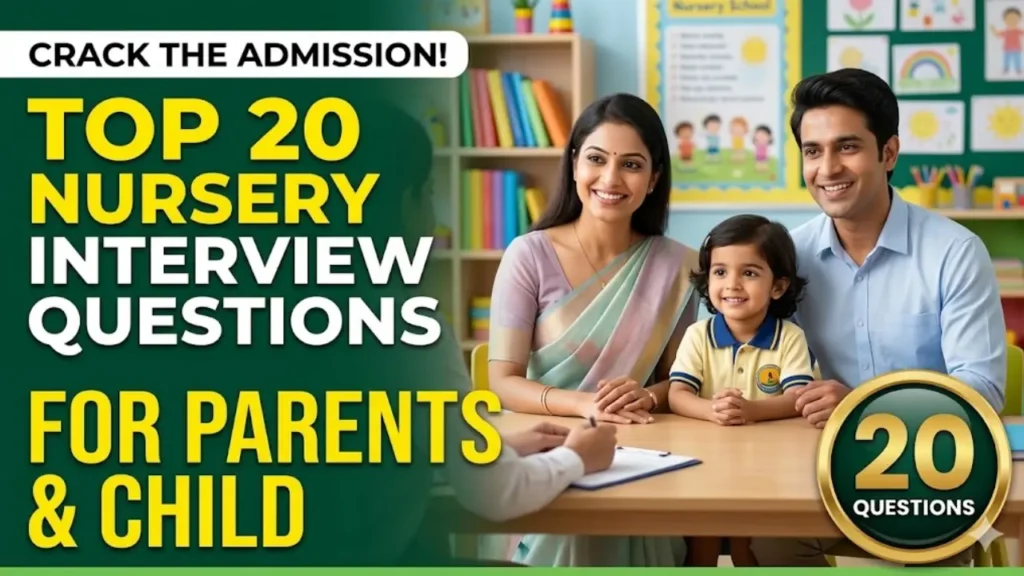
In our experience consulting with nervous parents, securing a seat in a reputed private school often feels more intimidating than preparing for a corporate board meeting. We completely understand the intense anxiety you face when thinking about sitting across from a strict school principal. You likely spend sleepless nights worrying if your three-year-old will cry, refuse to speak, or give the wrong answer during the interaction.
However, the truth is that modern schools are not looking for miniature geniuses who can recite the entire alphabet backwards. They simply want to understand your family dynamics, your parenting style, and whether your child is emotionally ready for a social environment. If you are searching for the Top 20 Nursery Admission Interview Questions, you have arrived at the perfect place to calm your nerves and prepare strategically.
We have created this comprehensive guide to break down exactly what principals ask the parents and how they interact with the child. By the end of this article, you will know exactly how to present your family as the ideal fit for their institution.
- Be absolutely honest and natural about your parenting style and family background.
- Do not over-coach or force your toddler to memorize robotic answers; natural behavior is preferred.
- Dress neatly in semi-formal or formal attire to show respect for the institution.
1. The Real Purpose of a School Interaction Round
Before diving into the specific questions, it is crucial to understand why schools conduct these sessions in the first place. Under the latest guidelines issued by the Ministry of Education on the education.gov.in portal, formal written testing or rigorous interviewing of toddlers is strictly prohibited. Therefore, reputed schools frame this process as a casual interaction rather than a formal test.
The primary goal of the school management is to ensure that the parents educational philosophy aligns with the schools core values. They want to check if the parents are heavily involved in their childs upbringing or if they outsource all responsibilities to nannies and tutors. Furthermore, they observe the childs basic motor skills and responsiveness to strangers.
Of course, before you even reach the interview stage, your child’s application must clear the initial screening. We highly recommend verifying your childs eligibility by checking our detailed guide on the Minimum Age for Nursery and LKG Admission to ensure your form is not rejected on technical grounds.
Once your paperwork is cleared and the interview date is set, the real preparation begins. In the next section, we will reveal the top ten questions specifically directed at parents and provide a clear comparison of what the school expects from you versus your child.
2. Top 10 Nursery Interview Questions for Parents
In our experience, the interview panel spends more time observing the parents than the toddler. They want to ensure that the home environment is conducive to the childs emotional and intellectual growth. Below are the ten most frequently asked questions you should mentally prepare for.
- How would you describe your childs nature? The panel wants to know if you actually spend enough time to observe your childs habits, introversion, or extroversion.
- How do you manage your childs screen time? They are checking your parenting discipline and whether you rely on mobile phones to pacify your toddler.
- Both parents are working, how do you manage time? They want to ensure the child is not left completely isolated or entirely dependent on a nanny.
- Why did you choose this specific school? Always research the schools core values and teaching methodology before answering this to show genuine interest.
- How do you handle your childs temper tantrums? Answer honestly about your patience, boundary-setting, and conflict resolution style.
- What are your views on homework and academic pressure? Modern schools prefer parents who believe in balanced growth rather than forcing rote learning.
- Is your child completely toilet trained? Most reputed private schools strictly require basic toilet training before granting final admission.
- What language is primarily spoken at home? Be honest, as the child will naturally reflect the home environment during their interaction.
- How do you reward or discipline your child? Focus your answer on positive reinforcement rather than physical punishment or yelling.
- What are your expectations from our institution? Keep your answer realistic, focusing on physical safety, moral values, and holistic development.
We highly advise parents to dress modestly and professionally. You do not need to wear a business suit, but neat, semi-formal attire creates a strong first impression. Avoid heavily perfumed clothes, flashy jewelry, or overly casual wear like shorts or graphic t-shirts. Maintain polite eye contact with the principal, speak softly, and never interrupt your spouse while they are answering a question.
Parents applying under special economic quotas often face slightly different administrative interactions regarding their paperwork. For example, if you are targeting the capital regions specific quota system, our Delhi EWS Nursery Admission 2026-27 guide covers those exact documentation and verification nuances.
Expectations: Parents vs. Child
Many parents mistakenly believe that their three-year-old is going to be tested on complex academic subjects. To clear this confusion, we have created a simple breakdown of what the school management actually expects from both parties during the interaction.
| Evaluation Parameter | What Schools Expect from Parents | What Schools Expect from the Child |
|---|---|---|
| Behavior and Conduct | Polite, cooperative, and aligned with school values | Basic responsiveness, even if slightly shy |
| Communication | Clear thoughts and honest answers | Ability to follow very simple verbal instructions |
| Academic Readiness | Willingness to support learning at home | Recognizing basic shapes or colors through play |
Now that you know how to present yourself, it is time to focus on the little one. In the next section, we will cover the exact questions asked to toddlers, how to prepare them without causing stress, and share a critical warning about the dangers of rote learning.
3. Top 10 Interaction Questions for the Child
In our experience observing modern school admissions, the interaction with the child is heavily play-based. The teacher or principal simply wants to see if the child can follow basic verbal instructions, recognize familiar objects, and separate from the parents for a few minutes without uncontrollable panic.
To understand exactly what level of academic knowledge is expected before formal schooling begins, we highly recommend reviewing our complete Nursery Class Syllabus 2026 PDF guide. This will give you a clear framework of the basic shapes and colors your child should ideally recognize. Below are the ten most common tasks or questions presented to toddlers.
- What is your name and how old are you? A simple icebreaker to test basic speech clarity.
- Are you a boy or a girl? This tests their basic self-awareness and understanding of gender.
- Can you hand me the red block? A test to check color recognition and ability to follow a direct instruction.
- Identify the object in this picture. They may show flashcards of a common fruit, animal, or a vehicle like a car.
- Where is your nose or eyes? Pointing to basic body parts shows their level of physical awareness.
- Who has come with you today? A casual question to see if they can identify mom, dad, or grandparents.
- Can you solve this simple puzzle? They might ask the child to fit a wooden circle or square into a matching board to test motor skills.
- What do you like to eat or play with? This encourages the child to speak a few words independently.
- Can you catch this soft ball? A very common physical activity to check hand-eye coordination and reflex.
- Will you recite a short rhyme for us? They do not expect perfection, just a willingness to participate and sing.
How to Prepare Your Child Naturally
Preparing a three-year-old for an interview should never feel like a classroom study session. Start practicing a month in advance by integrating these questions into your daily playtime. Ask them to fetch specific colored toys while organizing their playroom, or practice introducing themselves to visiting relatives.
We strongly warn parents against forcing their toddlers to memorize robotic, rehearsed answers. School principals are highly trained child psychologists who can instantly spot a child who has been excessively coached. If your child recites a perfect paragraph but fails to follow a simple instruction to pick up a pencil, it creates a massive negative impression. Natural curiosity, even if accompanied by a wrong answer, is always preferred over stressed, rote memorization.
Even with the best preparation, the interview might take an unexpected turn. In the final section, we will explain how to handle tricky questions gracefully, share a secret pro tip for answering the weakness question, and cover the most frequently asked queries regarding the admission interaction.
4. How to Handle Tricky Questions Gracefully
In our experience, principals occasionally throw a curveball question to see how parents react under mild pressure. They might ask how you would handle a situation where your child hits another student, or what you would do if you disagree with a teachers feedback. The key here is to remain calm and show a collaborative mindset.
Always base your answers on modern, gentle parenting techniques. If you want to understand the national benchmark for early childhood education, we suggest reviewing the NCERT official guidelines for foundational learning. It emphasizes holistic development over strict discipline.
If the panel asks about your childs weakness, never say that they have none, as that sounds unrealistic. Instead, frame a minor developmental phase as a work in progress. For example, you can say, our child is still learning how to share their favorite toys with cousins, but we are actively practicing taking turns at home. This shows you are self-aware and actively working on their social skills.
Ultimately, confidence and honesty are your best tools. Do not pretend to be the perfect parent. Schools appreciate genuine families who are willing to partner with them in the childs educational journey.
Frequently Asked Questions
How do I introduce myself in a nursery school interview?
What do they ask a 3-year-old in a school interview?
What happens if my child cries during the admission interview?
How should parents dress for a school admission interaction?
Conclusion
Cracking a private school admission is much easier when you approach it as a friendly conversation rather than a rigid test. Prepare your child through natural play, ensure your documents are perfectly organized, and walk into the principals office with a calm, positive mindset.
If you are facing an upcoming interaction round and have a specific tricky question in mind, please leave a comment below. Our community of experienced parents and educators will gladly help you frame the perfect answer.

Alok is the Founder and Chief Editor of StartAPreschool.in. A passionate Education Researcher & Blogger, he specializes in decoding Government Education Schemes, RTE Admission rules, and Preschool Business models in India. His mission is to provide accurate, transparent, and NEP 2020-aligned information to parents and edupreneurs.