
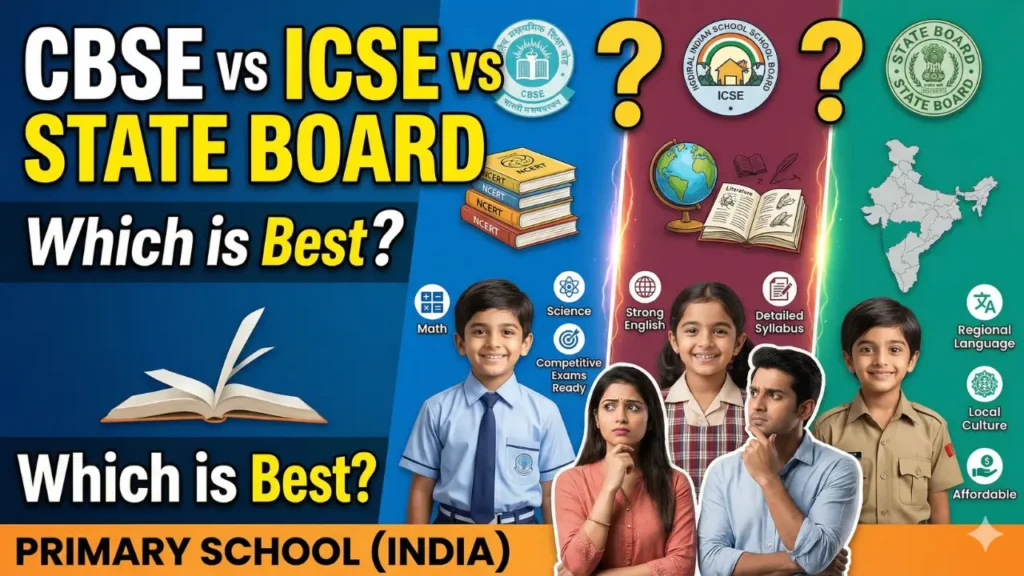
In our educational consulting experience, selecting the appropriate academic curriculum frequently creates immense anxiety for both new parents and aspiring educational entrepreneurs. When evaluating CBSE vs ICSE vs State Board: Which is Best for Primary School in India, founders must carefully balance national academic standards against local community expectations.
This critical decision permanently shapes a child’s early cognitive framework and dictates a newly established school’s operational commercial viability. Transitioning between completely different educational boards after the primary foundation is established often leads to severe academic stress for the young student.
Understanding the core philosophical differences between these three major academic councils before initiating admission or seeking school affiliation is absolutely mandatory. Please review the quick summary box below to grasp the foundational objective of each educational board.
| Central Board (CBSE) | Highly structured science and math syllabus, optimal for national competitive exams. |
| Council (ICSE) | Comprehensive global curriculum, superior focus on English literature and analytical skills. |
| State Boards | Highly localized content, cost-effective, excellent for regional state-level examinations. |
1. The Core Dilemma of Primary Education Boards
The Indian educational landscape offers multiple highly respected academic pathways, each designed with a distinctly different ultimate developmental objective. The central board focuses heavily on standardized mathematical concepts to ensure uniformity across the entire nation, making it an exceptionally safe choice for parents holding transferable jobs.
Conversely, the Indian certificate of secondary education emphasizes a significantly broader spectrum of subjects, demanding much higher linguistic proficiency from a very young age. For educational founders, offering an international standard curriculum often justifies a premium fee structure within competitive metropolitan cities.
Selecting the right board directly influences your initial campus design, teaching staff recruitment, and overall capital investment. To understand how these academic choices impact your foundational infrastructure planning, we highly recommend reviewing our comprehensive guide on How to Start Play School in India.
2. Comprehensive Comparison: CBSE, ICSE, and State Boards
In our academic structuring experience, founders and parents frequently make decisions based on localized peer pressure rather than objective educational metrics. To prevent establishing a mismatched academic foundation, one must critically analyze how each specific board approaches fundamental pedagogy during the formative primary years.
The matrix below provides a highly structured comparative analysis of the three primary educational frameworks currently operating within the Indian schooling ecosystem. This data will assist you in aligning your long-term academic expectations with the correct institutional affiliation.
| Analytical Parameter | Central Board (CBSE) | Council (ICSE) | State Education Boards |
|---|---|---|---|
| Primary Academic Focus | Mathematics and Core Sciences | English Literature and Global Arts | Regional Languages and Local History |
| National Transferability | Exceptionally High (Uniform across India) | Moderate (Limited to major urban cities) | Extremely Low (Strictly state-confined) |
| Competitive Exam Alignment | Directly aligns with JEE and NEET formats | Excellent for foreign university admissions | Highly optimized for state-level entrance exams |
Understanding the Central Board of Secondary Education (CBSE)
The Central Board represents the absolute gold standard for national uniformity. When parents holding transferable corporate or government jobs relocate across different states, the central board ensures the child experiences absolutely zero disruption in their ongoing academic curriculum. The primary syllabus relies heavily on the structured NCERT framework.
For educational founders, acquiring central board affiliation instantly elevates institutional credibility and guarantees high enrollment numbers. To physically understand the exact progression of this structured curriculum during the foundational years, we highly advise parents to review the complete UKG Syllabus 2026-27 CBSE PDF Download.
Understanding the Indian Certificate of Secondary Education (ICSE)
While the central board prioritizes scientific objectivity, the ICSE curriculum delivers a highly sophisticated, voluminous, and language-intensive education. This board mandates the study of classic English literature and complex analytical essays from a remarkably early age, fostering exceptional communication skills.
If your ultimate parental objective is securing undergraduate admissions in prestigious foreign universities across the United States or the United Kingdom, the ICSE framework naturally prepares the student for global language proficiency tests like TOEFL or IELTS without requiring external commercial coaching.
We strictly advise founders to note that the implementation of the National Education Policy is aggressively bridging the historical gap between these boards at the primary level. The government now legally mandates that all affiliated institutions, regardless of their board, must completely eliminate rote memorization in classes one through five. The modern primary curriculum is transitioning entirely towards experiential learning, foundational literacy, and critical cognitive development, standardizing the early childhood academic experience across the entire country.
3. The Strategic Advantages of Regional State Education Boards
In our educational market analysis, metropolitan parents and new institutional founders frequently underestimate the immense strategic value provided by regional state boards. These highly localized curriculums are specifically engineered to reflect the cultural, historical, and linguistic heritage of the specific home state, making education highly relatable for the child.
For educational entrepreneurs establishing institutions in tier-two cities or semi-urban districts, securing a state board affiliation is significantly more cost-effective. The administrative compliance regarding land requirements and campus infrastructure is generally less rigid compared to national councils, allowing for a faster and highly profitable institutional launch.
From a purely academic perspective, state curriculums remain exceptionally optimized for clearing regional engineering, medical, and state civil service examinations. The syllabus volume is intentionally kept manageable, providing young primary students with ample afternoon hours to pursue professional sports or specialized extracurricular training without academic burnout.
We issue a severe academic warning to parents who plan to enroll their child in a localized state board during primary school with the intention of switching to the highly rigorous ICSE or CBSE curriculum during middle school. The pedagogical transition from a regional syllabus to a complex analytical national framework creates a massive cognitive gap. This sudden educational shift frequently results in extreme academic anxiety, plummeting examination grades, and a completely shattered foundational confidence. You must carefully select one specific educational board in class one and strictly commit to it for their entire academic journey.
Navigating these complex academic choices dictates the ultimate success of both the student and the educational institution. In the final section, we will deliver our ultimate verdict, provide a highly strategic affiliation hack for school founders, answer frequently asked questions, and outline our legal disclaimer.
4. The Final Verdict on Primary Education Boards
Ultimately, selecting the optimal academic framework requires aligning your child’s learning style or your institution’s target demographic with the board’s inherent strengths. If you seek a standardized, scientifically rigorous, and highly transferable curriculum, the central board remains the undisputed leader. Conversely, for cultivating exceptional English proficiency and global analytical perspectives, the council syllabus is unparalleled.
For educational founders ready to take the next monumental step in institutional growth, understanding the complex bureaucratic transition from a state level to a national level is critical. We strongly recommend reviewing our comprehensive administrative breakdown on How to Get CBSE Affiliation for Primary School in India.
We highly advise new educational entrepreneurs operating with limited initial capital to launch their primary school exclusively with a state board affiliation. Securing municipal approvals and state recognition requires significantly smaller land parcels and minimal infrastructure investment compared to national boards. Once your campus achieves full enrollment capacity and generates steady operational revenue over three years, you can systematically upgrade your infrastructure and confidently apply for central board recognition.
Frequently Asked Questions
Which board is best for primary students in India?
Is ICSE harder than CBSE for class one to five?
Can we switch from State Board to CBSE in primary school?
Which board is better for future competitive exams like JEE and NEET?
Conclusion
Your primary school affiliation fundamentally dictates the entire trajectory of your academic journey or educational enterprise. Analyze your local demographic demands, evaluate your child’s inherent learning capabilities, and commit to a curriculum that fosters genuine intellectual curiosity rather than mere rote memorization.
If you are an educational founder struggling to decide between state and central affiliations, or a parent confused about curriculum volumes, please detail your exact situation in the comments below. Our network of curriculum consultants will provide a highly objective recommendation.

Alok is the Founder and Chief Editor of StartAPreschool.in. A passionate Education Researcher & Blogger, he specializes in decoding Government Education Schemes, RTE Admission rules, and Preschool Business models in India. His mission is to provide accurate, transparent, and NEP 2020-aligned information to parents and edupreneurs.