
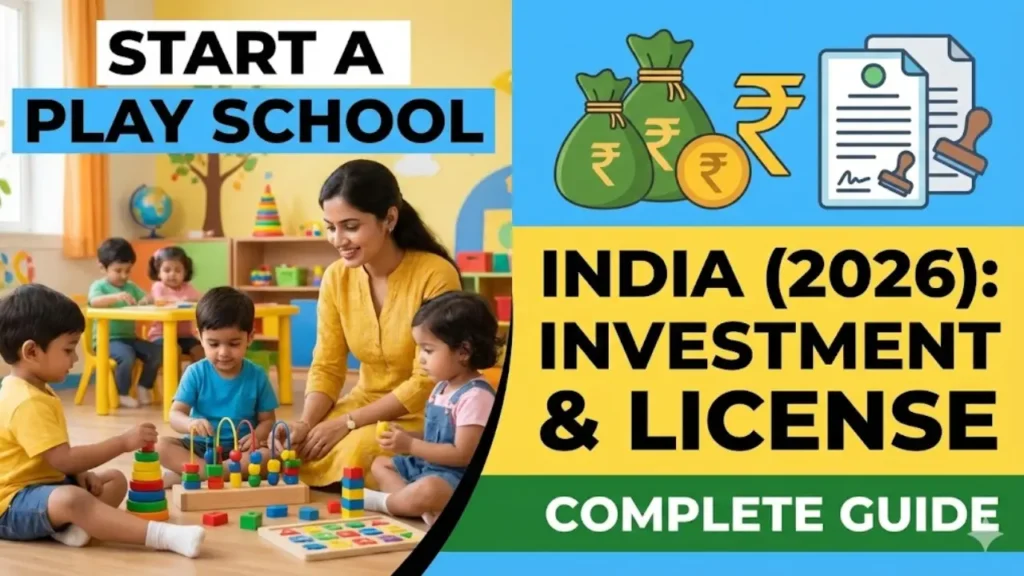
Are you planning to enter the recession-proof education sector? Starting a play school in India is widely considered one of the most profitable business ideas for 2026. With the implementation of NEP 2020, the demand for structured early childhood education has skyrocketed.
However, aspiring edupreneurs often face a common dilemma: “Should I buy a franchise or start my own brand?” and “What is the exact investment required?”.
If you are looking for answers, you are in the right place. This guide serves as your complete roadmap—from business planning and licensing to getting your first admission.
- Market Research: Analyze competitors within a 2-3 km radius.
- Business Model: Decide between a Franchise vs. Own Brand.
- Budgeting: Arrange an initial investment of ₹5 Lakh to ₹15 Lakh.
- Location: Secure a ground-floor property (Min 1500 sq. ft.).
- Licensing: Register your Trust/Society and obtain a Local NOC.
- Launch: Hire NTT-certified teachers and begin marketing.
1. Why Start a Play School in 2026? (Market Potential)
Before investing your capital, it is crucial to understand the market dynamics. The preschool market in India is projected to grow at a significant CAGR of 9.57% by 2028.
Two major factors are driving this rapid growth:
- Working Parents: In both metro and Tier-2 cities, dual-income households require a safe, learning-focused environment for their toddlers.
- NEP 2020 Focus: The government has formally recognized the “Foundation Stage” (Age 3-8), making preschool education mandatory. You can review the official guidelines on the Ministry of Education Website regarding the new curriculum framework.
2. Franchise vs. Own Brand: Which is Better?
This is the most critical decision you will make. Both models have distinct advantages and disadvantages. We have compared them below to help you make an informed choice.
| Feature | Buying a Franchise (e.g., Kidzee) | Starting Own Brand |
|---|---|---|
| Initial Investment | High (Franchise Fee: ₹2L – ₹10L) | Low (Only Infrastructure Cost) |
| Curriculum | Ready-made provided by Brand | Self-designed (Need Research) |
| Royalty Fee | 15% – 20% of Revenue (Lifetime) | 0% (100% Profit is yours) |
| Marketing Support | Brand Support Available | Self Effort Required |
| Operational Freedom | Low (Strict Brand Rules) | High (Your Rules) |
Our Recommendation: If you are new to the education business and have a budget exceeding ₹15 Lakhs, opting for a Franchise is safer. However, if you have prior teaching experience and want higher profit margins, starting your own brand is the superior choice.
Avoid opening a school on a highway or a busy main road due to safety concerns. Parents prefer a calm residential colony. Ensure your building is preferably on the Ground Floor. A small garden or open play area acts as a huge bonus for increasing admissions.
Once you have finalized your business model and location, the next major step is calculating the Financial Investment. Planning your budget accurately prevents cash flow issues later on.
3. Investment Breakdown: How Much Does It Cost?
Money is the biggest concern for any edupreneur. The cost of starting a play school depends largely on your location (Metro vs. Non-Metro) and the quality of infrastructure you plan to offer.
Below is a realistic Cost Estimation (2026) for setting up a standard preschool in a Tier-2 city (like Indore, Jaipur, or Lucknow) with a 1500 sq. ft. area.
| Expense Head | Estimated Cost (₹) |
|---|---|
| Property Deposit (Rental) | ₹50,000 – ₹1,00,000 |
| Furniture & Interiors (Colorful Theme) | ₹2,50,000 – ₹3,50,000 |
| Learning Aids & Toys (Non-Toxic) | ₹1,00,000 – ₹1,50,000 |
| Painting & Wall Art | ₹50,000 – ₹80,000 |
| Marketing & Launch | ₹50,000 – ₹1,00,000 |
| Miscellaneous (Licensing/Office) | ₹50,000 |
| TOTAL ESTIMATED BUDGET | ₹5.5 Lakh – ₹8.5 Lakh |
Note: If you own the property, you can save the rental deposit cost. However, keep a backup fund for at least 6 months of running expenses (Staff Salary + Electricity).
4. Infrastructure & Safety Norms (The “Wow” Factor)
Parents judge a school by its look and feel. Your infrastructure must be Child-Friendly and safe. The layout should encourage “Play-Way Learning” as suggested by NEP 2020.
Key Infrastructure Requirements:
- Classrooms: Must be well-ventilated with rounded furniture edges to prevent injury.
- Colors: Use bright colors like Yellow (Happiness) and Blue (Calmness). Avoid dark or dull shades.
- Washrooms: Separate toilets for boys and girls with child-sized commodes are mandatory.
- CCTV Cameras: Install cameras in every classroom and give live access to parents (optional but highly recommended for trust).
Safety is non-negotiable. Before opening, ensure you have:
- Fire Safety Certificate: Install fire extinguishers on every floor.
- First Aid Kit: Fully stocked for emergencies.
- Police Verification: Mandatory for all support staff (drivers, guards, and maids).
5. Curriculum & Staffing (The Backbone)
Once the building is ready, you need a soul for the school—the Syllabus and the Teachers.
The Curriculum (NEP 2020): Gone are the days of rote learning. Your syllabus must focus on Activity-Based Learning (ABL). This includes storytelling, clay modeling, and sensory play.
You can download the latest NEP-compliant monthly planners and worksheets from our Syllabus & Study Material section.
Hiring the Right Staff:
- Teachers: Always hire NTT (Nursery Teacher Training) or Montessori-certified teachers. They understand child psychology better than B.Ed teachers.
- Student-Teacher Ratio: Maintain a ratio of 1:15 (1 Teacher for every 15 Students) for personalized attention.
If you are looking to hire qualified staff or want to post a vacancy, check our Teacher Jobs page for the latest updates.
With your school ready and staff hired, the final and most crucial step is Marketing & Admissions. How do you get your first 50 students? Let’s discuss this in the next section.
6. Marketing Strategy: Getting Your First 50 Admissions
Building a school is easy; filling it with students is the real challenge. In 2026, traditional pamphlets are not enough. You need a mix of Digital and Offline Marketing.
A. Online Marketing (Digital Presence)
- Google My Business (GMB): This is mandatory. When parents search for “Best Play School near me”, your school must appear on Google Maps with photos and reviews.
- Social Media: Create an Instagram page. Post short reels of activities like “Sand Play” or “Story Time.” Parents love seeing happy kids.
- WhatsApp Groups: Create a broadcast list for inquiry parents to share updates about admission dates.
B. Offline Marketing (Local Reach)
- Open House Event: Before the launch, organize a “Free Drawing Competition” or “Baby Show.” Invite parents to visit your campus.
- Newspaper Inserts: Distribute colorful pamphlets in local newspapers (Hindi & English) within a 3 km radius.
- Banners: Place hoardings at nearby parks, grocery stores, and pediatric clinics.
7. Fee Structure & Profit Margin
How much should you charge? This depends on your competitors. If nearby schools charge ₹20,000/year, keep your fee around ₹18,000 to ₹22,000 initially.
ROI (Return on Investment): A well-managed play school can yield a profit margin of 35% to 50% within the second year. The first year is usually break-even.
Some states in India have a “Fee Regulation Act.” Before finalizing your fee structure, check with your local District Education Officer (DEO) regarding any caps on admission fees in your state.
As you plan your total student intake, you should also familiarize yourself with the government’s 25% free seat reservation policy. We highly recommend reading our detailed guide on the RTE Admission 2026-27 Online Form to understand how this mandatory quota applies to new private pre-primary schools.
Frequently Asked Questions (FAQ)
Do I need CBSE affiliation for a Play School?
What is the minimum area required to start?
Is the Preschool business profitable in 2026?
Can I start a school in a rented property?
Conclusion: Start Your Journey Today!
Starting a play school is not just a business; it is a noble contribution to society. You are shaping the future of the country. While the initial effort in licensing and infrastructure is high, the long-term rewards—both financial and emotional—are worth it.
If you follow this guide, focus on safety, hygiene, and love for children, your school will definitely succeed.
Have more questions about franchise costs or legal forms? Drop a comment below, and our expert team will guide you!

Alok is the Founder and Chief Editor of StartAPreschool.in. A passionate Education Researcher & Blogger, he specializes in decoding Government Education Schemes, RTE Admission rules, and Preschool Business models in India. His mission is to provide accurate, transparent, and NEP 2020-aligned information to parents and edupreneurs.
Pingback: NTT Course Fees, Duration & Admission 2026 (Real vs Fake Institutes) - startapreschool.in
Pingback: Cheapest Play School Franchise in India: Top 5 Under 1 to 5 Lakhs (2026) - startapreschool.in