
In our experience analyzing early education curriculums, parents often spend hours scrolling through the internet trying to find authentic study materials for their five-year-olds. It is incredibly frustrating to search for a proper study guide and end up downloading outdated 2022 worksheets or blurry images that are completely useless for home tutoring.
We understand that as a parent, you want to prepare your child for formal schooling without putting too much academic pressure on their young minds. Whether you are looking for the UKG Syllabus 2026-27 CBSE & ICSE PDF Download format or simply want to know what topics your child will learn this year, you need structured, updated, and accurate information.
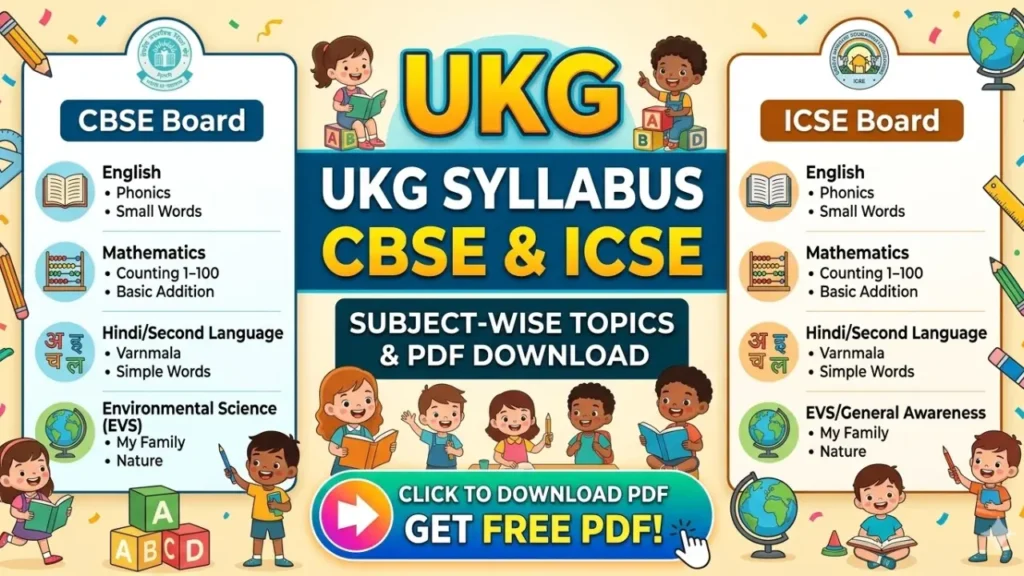
We have created this comprehensive, subject-wise guide to help you systematically teach your child at home. From basic phonics in English to simple addition in Mathematics, this updated curriculum will build a highly solid educational foundation before they step into Class 1.
| Target Age Group | Five to Six Years Old (Senior Kindergarten) |
| Core Subjects Covered | English, Mathematics, General Awareness (EVS), Hindi |
| Primary Focus Areas | CVC Words, Simple Sentences, Number Values, Environment |
| Official CBSE Portal | cbseacademic.nic.in (For General Reference) |
1. Overview of the Senior KG Education System
Upper Kindergarten marks the final and most crucial transitional phase in a childs early childhood education journey. Unlike the previous year, where the focus was entirely on recognizing letters and numbers, the Senior KG curriculum demands a slightly higher level of cognitive application and logical thinking.
If your child has just graduated from the lower kindergarten level, you must have noticed how their learning capacity has rapidly evolved. If you want to quickly revise the previous years topics before starting this new curriculum, we highly recommend checking out our comprehensive LKG Syllabus 2026-27 CBSE PDF Download guide to ensure no foundational gaps are left.
The new academic year introduces children to blending sounds, constructing short phrases, and understanding the logic behind basic math operations. In the next section, we will provide a detailed comparison between the two major educational boards and break down the exact English and Mathematics syllabus for your child.
2. Difference Between CBSE and ICSE UKG Syllabus
In our experience interacting with confused parents, the most common question is whether they should follow the central board pattern or the Indian certificate pattern for their five-year-olds. At the pre-primary level, the educational objectives of both boards are quite similar, focusing heavily on motor skills and basic cognition.
However, the teaching methodology and the pace of introducing new vocabulary differ slightly. The central board relies heavily on play-way and activity-based learning, while the other board introduces a slightly more structured thematic approach to early reading.
| Curriculum Feature | CBSE Pattern (Senior KG) | ICSE Pattern (Senior KG) |
|---|---|---|
| Primary Learning Approach | Activity-based and highly interactive | Thematic and slightly more structured |
| Language and Reading | Focuses on basic phonics and CVC words | Introduces sight words and longer sentences early |
| Environmental Science | General awareness of immediate surroundings | Detailed thematic projects on nature and society |
Before you begin teaching these advanced concepts, we highly recommend ensuring your child has fully mastered alphabet recognition and basic counting. If they are struggling, please revise using our Nursery Class Syllabus 2026 PDF guide before moving forward.
Detailed UKG English Syllabus 2026
The English curriculum for Senior Kindergarten shifts from merely identifying alphabet letters to actually reading and writing short words. The primary goal this year is to make the child comfortable with phonetics so they can independently decode simple text.
- Introduction to vowel and consonant sounds along with rigorous phonic drill practice.
- Reading and writing three-letter CVC words (Consonant-Vowel-Consonant) like cat, dog, pen, and mug.
- Understanding the concept of vowels (a, e, i, o, u) and matching words with similar sounds.
- Basic grammar concepts including the use of a and an, this and that, and these and those.
- Reading simple, short sentences using common sight words and picture reading exercises.
Detailed UKG Mathematics Syllabus 2026
The mathematics curriculum this year is designed to build a strong logical foundation. Children will move beyond simple counting and begin to understand the actual value of numbers, spatial relationships, and basic arithmetic operations using physical objects.
- Forward counting and writing numbers from 1 to 100, and backward counting from 50 to 1.
- Understanding number values through concepts like before, after, and in-between numbers.
- Introduction to basic comparison concepts such as greater than, less than, and equal to.
- Single-digit addition and subtraction using visual aids, pictures, and physical counting blocks.
- Identifying 2D shapes, reading time by the hour on a clock, and understanding heavy versus light objects.
With English and Mathematics forming the core academic base, the school also focuses heavily on environmental awareness. In the next section, we will break down the EVS syllabus and share a critical warning regarding your childs screen time during these learning hours.
3. General Awareness (EVS) and Regional Language Curriculum
In our experience tracking early childhood development, environmental science or general awareness is the most critical subject for a five-year-old. Unlike mathematics or reading, EVS directly connects the child to the real world around them. It builds their observation skills and answers their endless curiosity about everyday objects.
The UKG EVS syllabus focuses on making the child highly observant of their immediate environment, society, and personal hygiene. Parents can easily teach these concepts without using any textbook, simply by pointing out things during a walk or while doing household chores.
- My Body and Senses: Identifying external body parts, understanding the five senses, and basic personal hygiene habits.
- My Family and Home: Recognizing family relations, rooms in a house, and basic safety rules at home.
- The Living World: Differentiating between domestic, wild, and water animals, along with their babies and sounds.
- Community Helpers: Identifying doctors, teachers, police officers, and postmen, and understanding their roles.
- Transport and Seasons: Modes of transport by air, water, and land, basic traffic rules, and identifying different weather seasons.
We strongly advise parents to check with their target school regarding the second language requirement. While English is the primary medium, many CBSE and ICSE schools introduce Hindi or a regional state language in Senior KG. The Hindi syllabus generally includes tracing and reciting Swar (vowels) from a to aha, and Vyanjan (consonants) from ka to gya, along with recognizing two-letter words without any matra.
The Danger of Excessive Digital Learning at This Age
With numerous educational apps available today, parents often find it convenient to hand over a tablet to their child to learn poems or phonics. While digital tools are helpful in extreme moderation, they can severely impact a childs attention span and physical development.
We strongly warn all parents against relying entirely on mobile screens, animated videos, or interactive apps to complete the UKG syllabus. Excessive screen time at the age of five heavily disrupts sleep patterns, reduces fine motor skill development (like pencil grip), and limits natural social interactions. A child learns phonics and counting much faster when they physically interact with wooden blocks, flashcards, or a simple blackboard.
Now that you are aware of the complete subject-wise breakdown, the next logical step is to get the study materials. In the final section, we will explain how to download the complete syllabus PDF, share a brilliant practice hack, and answer the most frequently asked questions.
4. How to Download the UKG Syllabus 2026 PDF
In our experience, having a physical printed copy of the curriculum is much more effective than reading it off a screen. Both major educational boards frequently update their early childhood learning frameworks to align with modern pedagogical standards.
While the central board provides detailed guidelines on their academic portal, parents seeking information on the other prominent board should periodically check the CISCE Official Website for any new thematic changes in the pre-primary section. To make things easier, we have compiled the entire subject-wise breakdown into a single, printable document.
We highly advise parents to step away from traditional worksheets and use real-life objects to teach UKG concepts. Instead of making your child write numbers repeatedly in a notebook, ask them to count the apples in the kitchen or read the two-letter words on a cereal box. When children realize that mathematics and reading apply to their daily lives, their learning speed increases dramatically.
You can access the complete compiled curriculum file from the download section at the bottom of this page. Print it out and pin it to your childs study board to track their monthly academic progress systematically.
Frequently Asked Questions
Is there any difference between CBSE and ICSE UKG syllabus?
What subjects are taught in the UKG class?
How can I download the UKG syllabus 2026 in PDF format?
What should a UKG student know in mathematics?
Conclusion
Preparing your child for Class 1 does not mean burdening them with heavy textbooks. By following this structured UKG curriculum, you can naturally build their reading abilities and mathematical logic through simple daily activities. Keep the learning process joyful, completely avoid long digital screen times, and focus on their physical motor skills.
If you have any specific doubts about the English phonics patterns or need help finding the right activity worksheets for your five-year-old, please leave a comment below and our team will guide you.

Alok is the Founder and Chief Editor of StartAPreschool.in. A passionate Education Researcher & Blogger, he specializes in decoding Government Education Schemes, RTE Admission rules, and Preschool Business models in India. His mission is to provide accurate, transparent, and NEP 2020-aligned information to parents and edupreneurs.